Print Media & Packaging Technologies


Scientific thinking remains!
Scientific thinking remains one of the most future-proof competencies that education can provide. Print Media and Packaging Technologies prepares students for an industry that is changing rapidly through artificial intelligence, automation, sustainability, and globalisation. The programme is not limited to traditional printing and packaging processes; it combines engineering, materials science, packaging technology, media production, intelligent workflows, data management, sustainability, and intercultural communication. Students first build a strong foundation in mathematics, physics, chemistry, and engineering, because these subjects develop analytical thinking and the ability to understand complex systems. They then apply this knowledge in laboratories, industrial projects, internships, and research-based work.
In a world where AI can generate content, analyse data, and automate routine tasks, graduates need more than technical knowledge. They must be able to ask the right questions, evaluate results, recognise bias, solve unfamiliar problems, communicate across cultures, and take responsibility for technological and societal change. This is why the programme combines practical engineering education with intercultural competence, language learning, industry experience, and independent research. It educates future engineers who can understand, improve, and responsibly shape the systems behind modern print, packaging, and media production.

Print Media and Packaging Technologies
This is what the degree programme is really like: practical experience, creativity, the future. At HdM Stuttgart, it’s not just about theory – it’s about what really matters: putting ideas into practice.
On our Bachelor’s degree programme in Print Media and Packaging Technologies, students work alongside companies such as Bosch, Schreiner Group and Giesecke & Devrient to develop for example real-world packaging – from the initial idea right through to the prototype. Whether it’s digital printing processes, sustainable materials or innovative design solutions – here, technology is combined with creativity.
Curriculum
Getting into details!
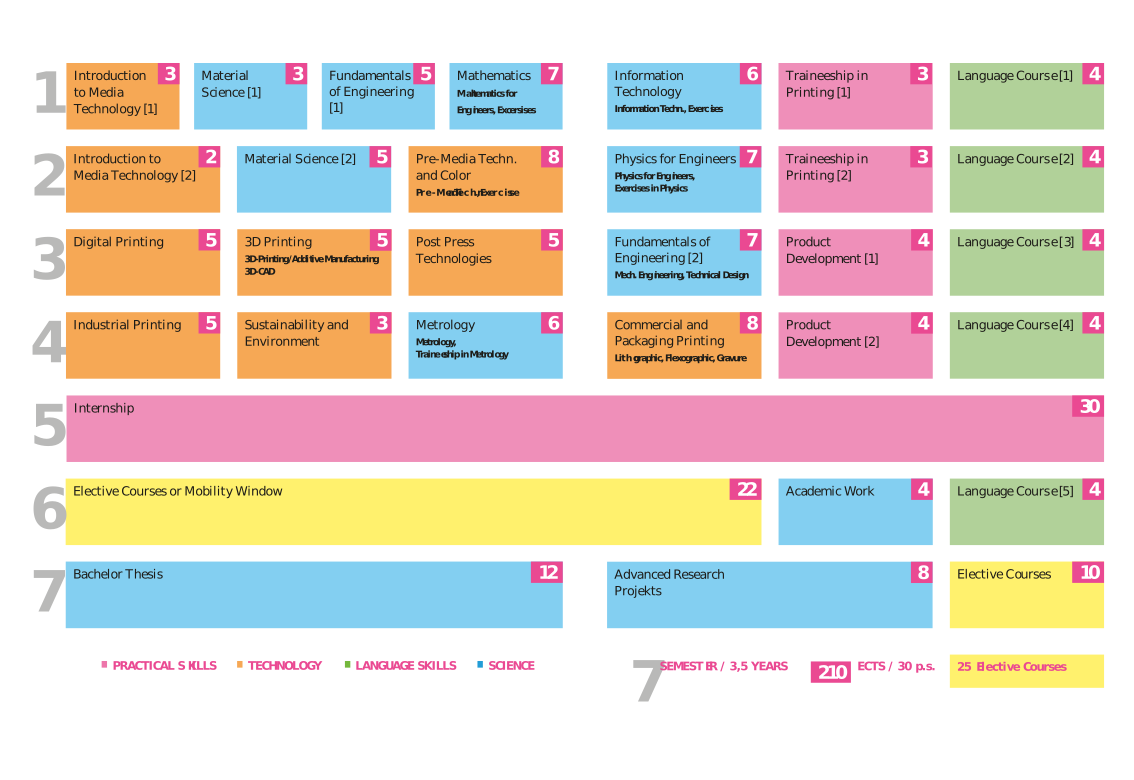
All of the courses offered at Hochschule der Medien (University of Applied Sciences) are credit rated. The program runs over 7 semesters (3 ½ years), and each semester is worth 30 credit points, which are obtained by successfully passing examinations. To be awarded the B.Eng. qualification, you must accumulate a total of 210 credits (ECTS).
The curriculum combines engineering fundamentals with practical industry experience. Students build a strong foundation in the sciences before specialising in print and packaging technologies, intelligent manufacturing, sustainability, and automation through laboratory work and real-world projects.
A compulsory six-month industry internship, international study opportunities, and a research-based Bachelor's thesis ensure that graduates develop the technical expertise, practical experience, and intercultural skills needed for successful careers in the global print and packaging industry.
Overview
Semester_One
- Introduction into Media Technology
- Traineeship in Printing (1)
- Material Science
- Mathematics for Engineers
- Information Technology
- Language Course
Semester_Two
- Traineeship in Printing (2)
- Material Science
- Pre-Media Technology an Color
- Physics for Engineers
- Language Course
Semester_Three
- Product Developement
- Digital Printing
- Post Press Technologies and Product Design
- Additive Manufacturing
- Fundamental of Engineering
- Language Course
Semester_Four
- Product Developement
- Commercial and Packaging Printing
- Industrial Printing
- Metrology
- Sustainability and Environment
- Language Course
Semester_Five
Semester_Six
- Campaign Management
- Academic Work
- Language Course
Semester_Seven
- Bachelor Thesis
- Advanced Research Project